
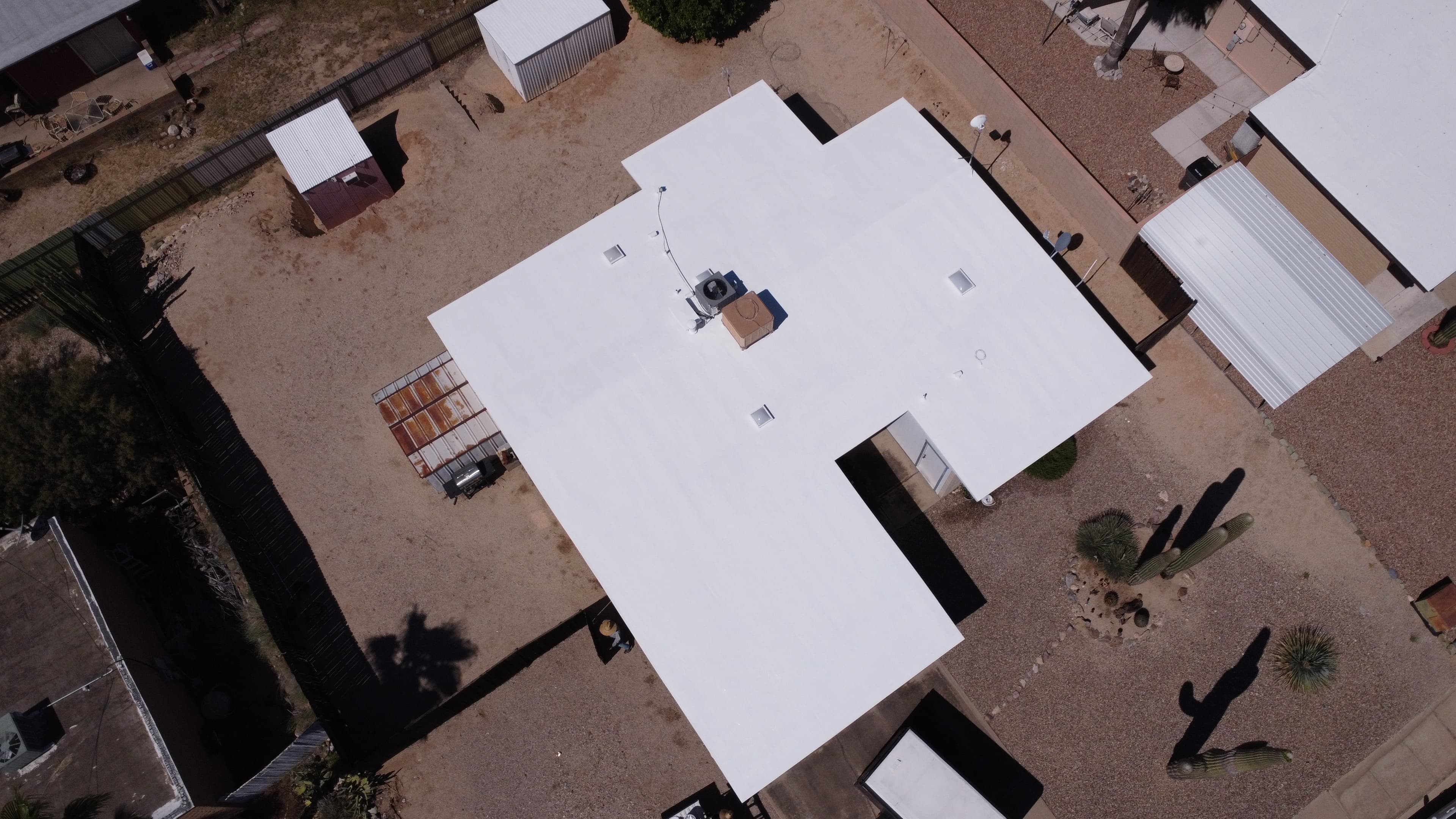
Services/Flat-roof coating
Flat-Roof Coating & Recoating across the Tucson metro.
Flat-roof systems for Tucson — built-up modified bitumen, single-ply membrane, and reflective elastomeric coatings. Designed for the temperature swings, UV exposure, and monsoon cycles that destroy lesser systems.
- Free estimate within 24 hours
- Family-owned · Tucson · Since 2014
- 1,000+ roofs across Pima & Cochise County
- Drone-inspected — start to finish
- Federal: Fort Huachuca · Sierra Vista AFB · Tucson VA
In short
Flat-roof coating in the Tucson metro is the maintenance and recoat work that keeps modified-bitumen, single-ply, and elastomeric flat-roof systems alive in the desert. Most Tucson flat roofs need a recoat every 8–12 years to maintain reflectivity and waterproofing — UV and dust break down the surface coating long before the substrate fails. We pressure-wash the existing roof, repair any blisters or cracks, and apply a fresh elastomeric reflective coating that drops attic temps by 10–20°F and extends the substrate life by another decade.
- Lifespan
- Coating 8–12 years · Full system 15–30 years
- Typical job
- 1–3 days for a recoat · 5–10 days for full replacement
- Best fit for
- Flat or low-slope roofs, residential or commercial
Plain English
What a flat-roof recoat actually is.
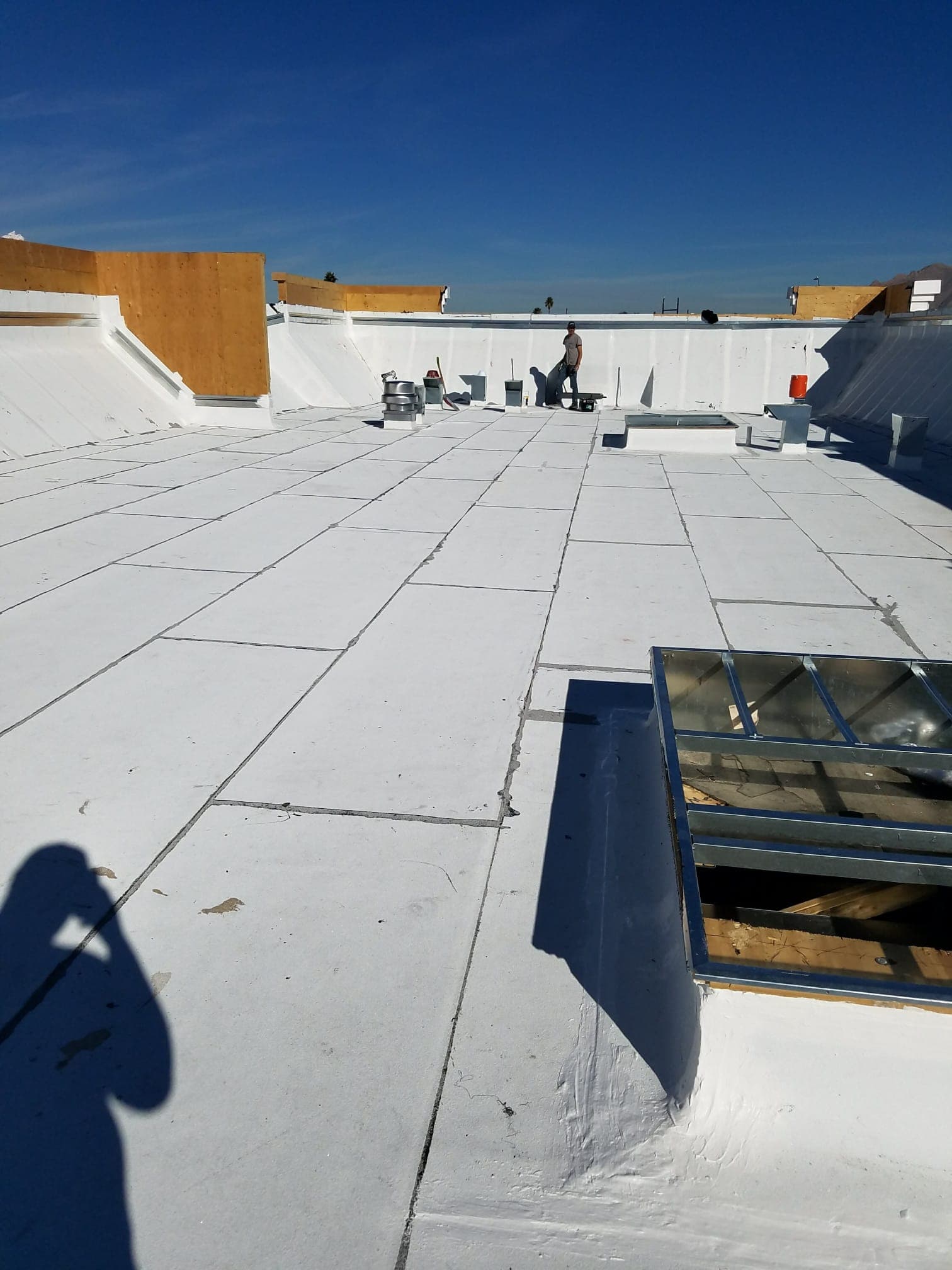
A flat or low-slope roof system protects buildings without a steep pitch — most commercial properties, ranch-style homes, additions, and patios. The right system depends on the existing structure, slope, drainage, and how the building is used. We work in built-up modified bitumen, single-ply (TPO and modified), and reflective coatings, sometimes layered together for long-life performance in the Sonoran climate.
Local conditions
What kills flat roofs in Tucson.
Three things from the field —
- I
Heat and UV are the killers.
Tucson sun degrades flat-roof coatings 30% faster than coastal climates. Reflective coatings that hold 12 years in California fail at 8 here. Reapplying reflective coating on schedule is the single most effective maintenance you can do on a flat roof in this climate.
- II
Ponding water is rare but punishing.
Most Tucson flat roofs drain well during monsoon, but where ponding does happen — low spots, plugged scuppers, settled decks — the water sits longer and bakes harder than in other climates. Ponded water at 130°F surface temperature degrades coatings in months, not years.
- III
Ag-area dust shortens coating life on the south side.
Pecan groves and farm operations south of Tucson generate dust that settles on flat roofs and shortens reflective coating life by 20–30% in the south Pima corridor (Sahuarita, Green Valley). Annual cleaning is the cheapest meaningful maintenance for those properties.
Signs to call
When a recoat is due.
- 01You're seeing pooling water, soft spots, or visible bubbling on a flat roof.
- 02Interior leaks during monsoon storms, even from a roof that looks intact.
- 03A previous coating is chalking, cracking, or peeling — common after 8–12 years of UV.
- 04The current roof has reached the end of its warranty period (typically 10–20 years).
- 05Your energy bill keeps climbing — a fresh reflective coating can drop cooling load.
Our approach
How a flat-roof recoat or replacement goes.
Step-by-step from inspection to walkthrough — the approach we follow on every job.
- 01
Inspection first — we identify what kind of system is currently on the roof, where it's failing, and what's salvageable. Sometimes a full tear-off isn't needed.
- 02
Power-wash and prep — we clean the deck or existing membrane down to a sound substrate. This is the step most contractors rush; we don't.
- 03
Apply the system spec'd for your roof: self-adhered modified bitumen, TPO single-ply, or a multi-layer reflective coating. We choose based on the building, not what we want to sell you.
- 04
Reflective top coat where appropriate — meaningful summer cooling cost savings in Tucson, plus extends roof life.
- 05
Walkthrough and warranty docs at the end. You know exactly what's on your roof and what to expect.
The spec
Coating systems and what shapes the price.
Timeline —Recoats over a sound roof: 1–3 days for most residential and small commercial. Full tear-off and replacement: 5–10 days depending on size and complexity. Larger commercial jobs are phased so the building stays usable.
What affects the cost —
- 01
Existing roof condition — sound substrate is a recoat; failed substrate means full tear-off.
- 02
Square footage — commercial flat roofs scale with area more directly than residential.
- 03
Roof access — single-story walk-on vs. equipment hoist on a multi-story building.
- 04
System spec — TPO single-ply, modified bitumen, or reflective coating each price (and last) differently.
Flat-roof coating mistakes that turn into call-backs — what we watch for.
Recoating over a failed substrate.
A coating buys you years of life on a sound substrate. On a substrate that's already failed (visible blistering, soft spots, water staining underneath), a recoat just delays the inevitable while making the eventual tear-off harder. Substrate testing first.
Skipping the pressure-wash.
Coatings don't bond to dust, oxidation, or old failed coating. Skipping pressure-wash is how a fresh coat starts peeling within a year. We power-wash to a sound substrate every time, even when it's tedious.
Wrong coating for the use.
Different coatings for different purposes — elastomeric for reflectivity and crack-bridging, modified bitumen for new construction, single-ply for commercial. Some contractors use whatever's cheapest. We spec by use case, not by what's on the truck.
Not addressing ponding before coating.
Ponding water destroys coatings in months. If you have ponding, the right move is to add tapered insulation or new drains FIRST, then coat. Coating over ponding is throwing money away.
Recent work
From the field.
Flat-roof coating, common questions.
The questions we hear most before homeowners sign — pricing, timing, materials, warranty.
01What's the difference between a coating and a recoat?
A coating is a fresh elastomeric layer applied over a sound existing roof — extends life by 8–12 years and improves reflectivity. A recoat usually means stripping a previous failed coating and applying new. We assess the existing system before deciding which approach fits.
02How long does a flat-roof coating last in Tucson?
A quality elastomeric reflective coating lasts 8–12 years in Tucson sun. A full modified bitumen system lasts 15–25 years. Single-ply TPO can run 20–30 with proper installation. The harder the climate, the more the prep work matters.
03Will a reflective coating actually lower my AC bill?
Yes — measurably. A bright white reflective coating reflects 80%+ of solar radiation versus 10–25% for a dark roof. In Tucson summers, that translates to lower attic temperatures and meaningful cooling cost savings, especially on commercial buildings with large roof areas.
04Do you do commercial flat roofs too?
Yes — see our Commercial Roofing page. We've done federal projects (Fort Huachuca, Sierra Vista AFB, Tucson VA), retail, and warehouse roofs. Flat-roof work scales the same way; the prep and material spec just gets more detailed.
05How do I know if my flat roof needs a recoat or a full replacement?
Substrate condition. If pressure-washing reveals a sound substrate (no widespread blistering, no soft spots), recoat works and lasts 8–12 more years. If the substrate shows widespread failure, a recoat over it just delays the inevitable. We do drone inspection plus on-roof substrate testing and give you both quotes so you can decide.
06Can a flat-roof coating actually drop my Tucson AC bill?
Yes, measurably. A bright white reflective coating reflects 80%+ of solar radiation versus 10–25% for an older dark roof. In Tucson summers, that translates to 10–20°F lower attic temperatures and meaningful cooling cost savings. Most homeowners see the AC bill drop within the first month after recoat.
07How long does the typical Tucson flat-roof recoat take?
One to three days for most residential and small commercial recoats. The first day is pressure-wash and substrate prep; the second is coating application; the third is touch-ups and walkthrough. Larger commercial roofs can run 5–10 days depending on size and access.
08Do I need to be home during a flat-roof recoat?
No, the work happens entirely from the roof. There's no interior disruption. There can be light coating odor for a day or two, especially with elastomeric systems — minimal but noticeable. Pets and family can stay.
Where we work
Flat-roof coating across the metro.
Pima County metro — click a city for area-specific work patterns, HOA standards, and recent jobs.
Reviewed by —Efren CoronadoOwner & lead estimator, Coronado Roofing. Tucson roofer since 2014. Flat-roof work focused on Sonoran-style residential, mid-century homes in Casas Adobes, and commercial/federal flat-roof systems. FAA Part 107 drone-certified.
Last updated —
Other services
Other roofing we do.
Same crew, same drone-first inspection, same materials — across every kind of roof we work.
Ready for a real quote?
Drone inspection. Honest assessment. No pressure.
Mon–Fri · 7am–5pm·Saturday by appointment