
Services/Drone inspection
Drone Roof Inspections across the Tucson metro.
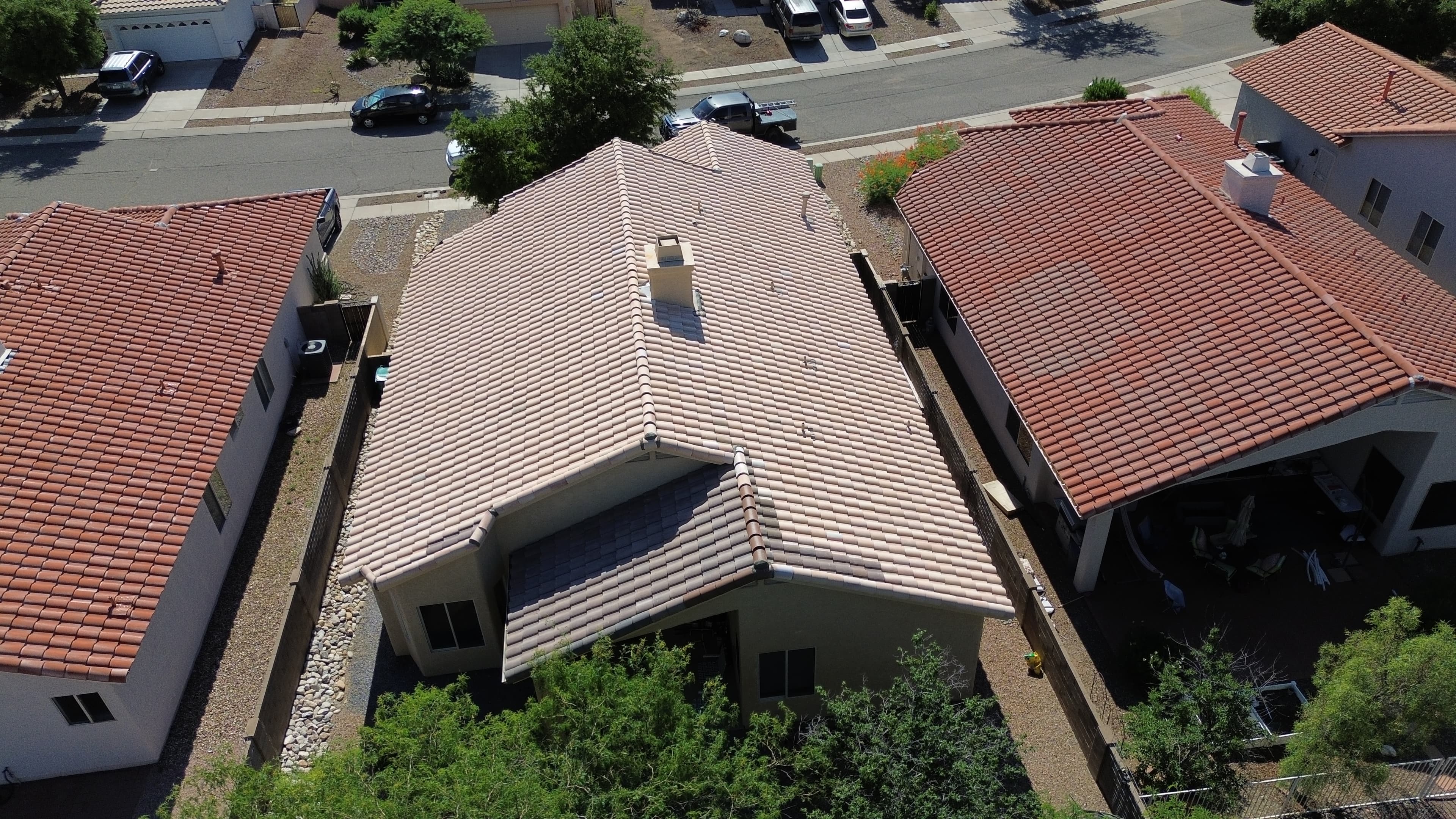
Drone roof inspections across Tucson and Pima County. We fly a high-resolution camera over the roof so we don't crack tiles by walking on them — and you see the same footage we do. Free as part of any quoted work; standalone when you need documentation for insurance, a real estate transaction, or peace of mind.
- Free estimate within 24 hours
- Family-owned · Tucson · Since 2014
- 1,000+ roofs across Pima & Cochise County
- Drone-inspected — start to finish
- Federal: Fort Huachuca · Sierra Vista AFB · Tucson VA
In short
Drone roof inspections in the Tucson metro are how we assess concrete tile, clay tile, and shingle roofs without walking on them — the only honest way to inspect tile in this market. Most Tucson roofs we inspect are 15+ years old, and walking aged tile cracks tiles that were perfectly sound. Our inspections take 30–45 minutes on site, include 4K imagery and a written assessment within 48 hours, and are free as part of any quoted work — or available standalone for insurance documentation, real estate transactions, and pre-monsoon assessment.
- Lifespan
- Documentation valid 12 months
- Typical job
- 30–45 min on-site · written report within 48 hours
- Best fit for
- Tile roofs, insurance claims, pre-purchase, pre-monsoon
Plain English
What a drone roof inspection actually is.
A drone inspection is a full roof assessment from the air, using high-resolution imagery to find damage that's hard to see from the ground or risky to find by walking. On clay and concrete tile roofs especially, walking the surface can crack tiles that were perfectly sound — so a drone is often the only honest way to inspect. We fly the entire roof, capture stills and video, mark up problem areas, and walk you through what we found.
Local conditions
Why drone-first matters in Tucson.
Three things from the field —
- I
Tucson is a tile metro.
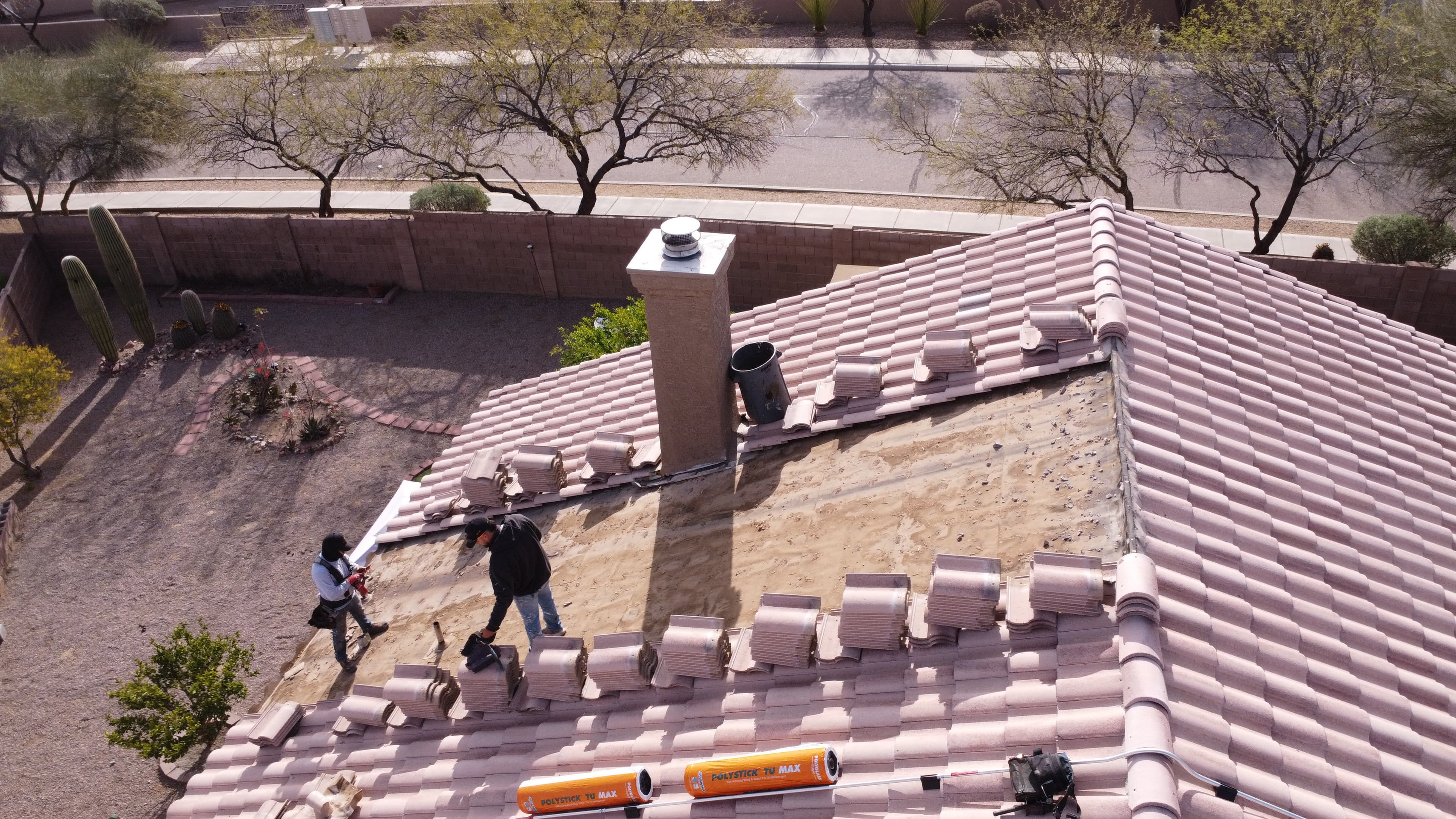
Half the homes in the Tucson metro have tile roofs — concrete in master-planned subdivisions, clay in older customs and Catalina Foothills estates, mixed everywhere else. Walking these roofs to inspect them is how the inspector becomes the cause of the damage. Drone-first is the only honest standard for this market.
- II
Insurance documentation matters here.
Monsoon season generates a steady stream of legitimate insurance claims — wind-lifted tiles, hail bruising, debris damage. Adjusters want documentation. Drone footage and a written assessment from a licensed contractor are accepted by State Farm, Allstate, Farmers, and most major Arizona insurers. Without that, claims get pushed back.
- III
Pre-monsoon prep is the highest-leverage maintenance.
May and early June are the right window for pre-monsoon inspections. We catch loose flashing, cracked tiles, worn coating, and any debris-related concerns before the storms hit. Costs nothing if it's part of quoted work; small flat-rate fee if standalone documentation only.
Signs to call
When a drone inspection is the right call.
- 01You're buying a home and want an independent assessment beyond the general inspection.
- 02Insurance is requesting documentation for a damage claim — we provide footage and a written report.
- 03Pre-monsoon prep — catch loose flashing, cracked tiles, or worn underlayment before the storms hit.
- 04Post-storm — assess hail, wind, or debris damage without sending someone up the ladder.
- 05You suspect a leak but the source isn't obvious from inside — drone imagery often pinpoints it.
- 06Your roof is older and you want to plan for repair vs. replacement before something fails.
Our approach
How an inspection goes.
Step-by-step from inspection to walkthrough — the approach we follow on every job.
- 01
We schedule the flight for daylight hours when the sun isn't directly overhead — better contrast, better images. Most inspections take 30–45 minutes on site.
- 02
Full overhead pass plus low-angle shots of every slope, valley, ridge, and penetration. Chimneys, vents, skylights, and HVAC curbs get individual close-ups.
- 03
We mark every issue in the imagery — cracked tiles, lifted flashing, exposed underlayment, ponding, granule loss — and rank by urgency.
- 04
Written assessment delivered within 48 hours: what we found, what needs immediate attention, what can wait, and what's still in good shape.
- 05
Walkthrough by phone or in person if you want to ask questions. If you decide to move forward with repairs or a re-roof, the inspection cost is credited to the work.
The spec
What we fly and what shapes the price.
Timeline —On-site: 30–45 minutes for most homes, 1–2 hours for larger commercial roofs. Written report: within 48 hours of the flight. Same-day turnaround available for urgent insurance claims or real estate timelines.
What affects the cost —
- 01
Roof complexity — single-slope ranch is faster than multi-pitch with skylights and chimneys.
- 02
Documentation depth — quick assessment vs. full insurance-grade written report.
- 03
Same-day turnaround — premium for urgent insurance or real estate timelines.
- 04
Free with quoted work — credited back if you move forward with repair or replacement.
Inspection shortcuts that miss what matters — what we don't do.
Walking the roof to inspect.
Most Tucson contractors still walk tile roofs to assess them. On 25-year-old concrete tile in summer heat, the inspector becomes the cause of cracked tiles. Drone-first avoids this entirely.
Generic drone footage with no analysis.
Some inspections are just drone footage handed over with no analysis. The value of the drone is in identifying what matters — cracked tiles, lifted flashing, exposed underlayment, ridge cap mortar issues — and ranking them by urgency. Footage without analysis is just photos.
Insurance-grade documentation that isn't actually insurance-grade.
Adjusters want stills, video, written notes from a licensed contractor, and clear before/after where applicable. Many 'drone inspection reports' don't include enough to support a claim. We document to the standard insurance accepts.
Charging for what should be free.
A drone inspection that leads to quoted work should be free; that's how reputable contractors operate. Some contractors charge for inspection regardless. We credit the inspection cost back if you move forward with work.
“Walking a 25-year-old tile roof to inspect it is how the inspector becomes the cause of the damage. Drone-first isn't a feature — it's the only honest standard in this market.”
Drone inspections, common questions.
The questions we hear most before homeowners sign — pricing, timing, materials, warranty.
01Is the drone inspection actually free?
Free when it's part of a quote for repair or replacement work. Standalone inspections — for insurance documentation, real estate, or peace of mind — are a flat-rate service. If you move forward with work after a paid inspection, we credit the cost back.
02Why a drone instead of just walking the roof?
On tile roofs, walking the surface can crack tiles that were perfectly sound. We've seen homeowners get charged for tile damage caused by the inspector. A drone reads the entire roof without touching it. On flat roofs and shingles, drones also capture overall patterns (ponding, granule loss, slope-wide wear) better than spot-walking does.
03Will insurance accept drone footage as evidence?
Yes — most major insurers do, particularly with a written assessment from a licensed contractor. We've worked with State Farm, Allstate, Farmers, and others on Tucson claims. We document with stills, video, and written notes that adjusters can review remotely.
04Can you fly in monsoon weather or high wind?
No — drones don't fly safely in winds above ~25 mph or in active rain. Post-monsoon, we usually wait a day or two for conditions to settle. Pre-monsoon inspections are best scheduled May through early June, before the season starts.
05How long does a typical Tucson drone inspection take?
On-site time is 30–45 minutes for most homes — we set up the drone, fly the entire roof with overhead and low-angle passes, and capture close-ups on every penetration, valley, and ridge. Larger commercial roofs can take 1–2 hours. Written assessment with stills, video, and notes is delivered within 48 hours of the flight.
06Can a drone inspection identify problems I can't see from the ground?
Yes — that's the point. From the ground you can see tile alignment and obvious damage. The drone reads underlayment fatigue, hairline cracks in tiles, lifted flashing, ridge cap mortar issues, granule loss patterns, and ponding on flat roofs. Most of what determines roof condition is invisible from below.
07Are you FAA-certified for commercial drone work?
Yes — FAA Part 107 certified, which is required for commercial drone work and respected by insurance adjusters. We carry the documentation and follow FAA airspace rules: no flights in restricted airspace without authorization, no flights over crowds, etc.
08Can I get a drone inspection for a home I'm thinking of buying?
Yes — pre-purchase inspections are a regular service we provide for Tucson real estate transactions. Same drone flight, same written assessment, delivered within 48 hours. Useful for negotiating, lender requirements, and knowing exactly what you're inheriting. We do these every week, especially in the Foothills and on older homes.
Where we work
Drone inspection across the metro.
Pima County metro — click a city for area-specific work patterns, HOA standards, and recent jobs.
Reviewed by —Efren CoronadoOwner & lead estimator, Coronado Roofing. Tucson roofer since 2014. Personally flown over 1,000 drone inspections across Pima County, including pre-purchase, insurance documentation, and pre-monsoon assessments. FAA Part 107 drone-certified.
Last updated —
Other services
What we do beyond inspections.
Same crew, same drone-first inspection, same materials — across every kind of roof we work.
Ready for a real quote?
Drone inspection. Honest assessment. No pressure.
Mon–Fri · 7am–5pm·Saturday by appointment