
Services/Commercial
Commercial Roofing across the Tucson metro.
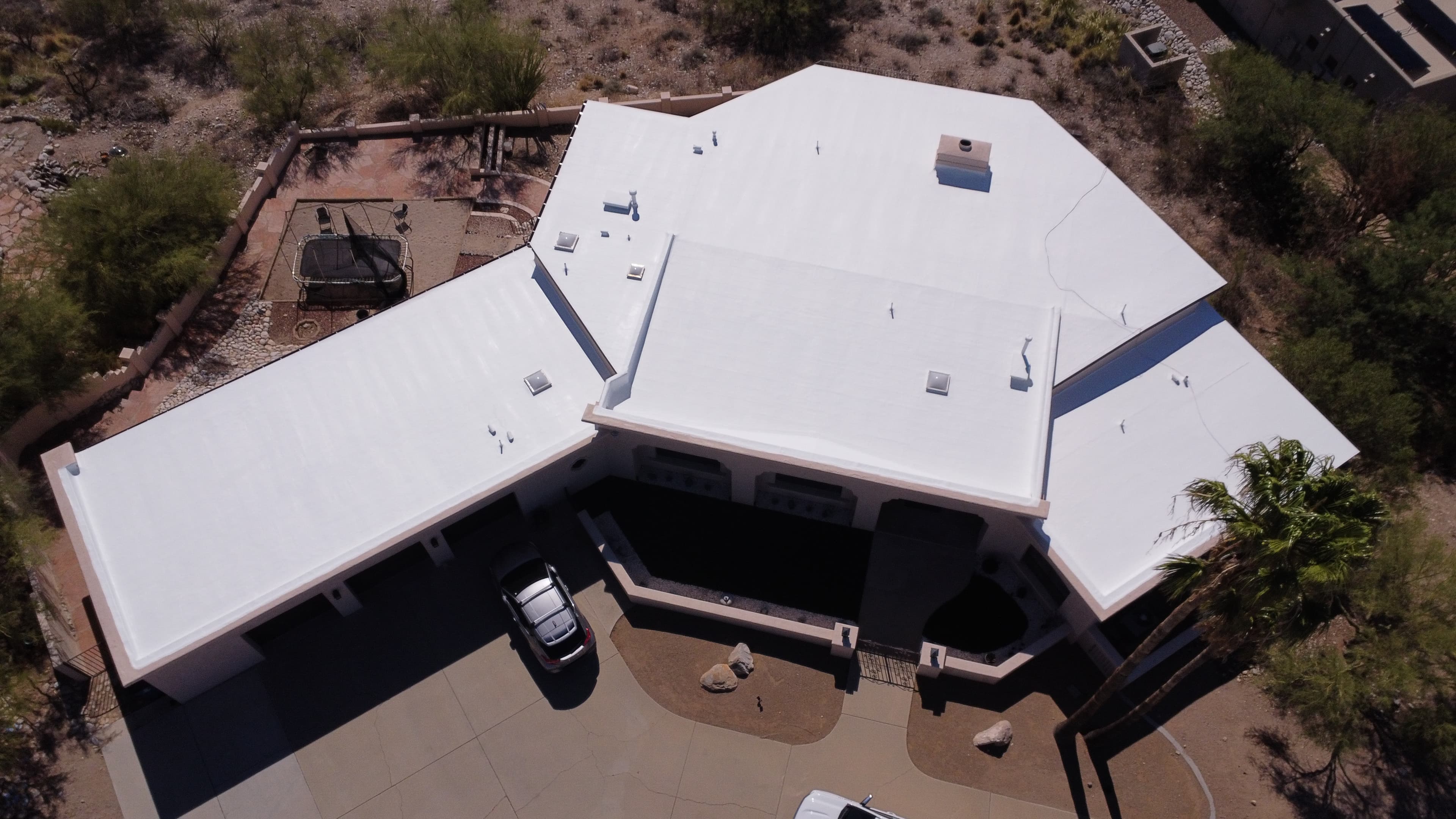
Commercial roof systems for Tucson businesses, schools, and federal facilities. Built-up modified bitumen, single-ply TPO and PVC, and rubberized coatings — all sized to your roof, your building's use, and your budget timeline.
- Free estimate within 24 hours
- Family-owned · Tucson · Since 2014
- 1,000+ roofs across Pima & Cochise County
- Drone-inspected — start to finish
- Federal: Fort Huachuca · Sierra Vista AFB · Tucson VA
In short
Commercial roofing in the Tucson metro covers flat-roof systems on retail, office, restaurant, federal, and industrial buildings — TPO single-ply, modified bitumen, PVC, and reflective elastomeric coatings. We've completed federal projects at Fort Huachuca, Sierra Vista AFB, and the Tucson VA, plus retail and office work along Tucson's main commercial corridors. Most commercial work in the metro is recoats, full replacements on aged systems, or new construction — and we phase the work so the building stays operational throughout.
- Lifespan
- TPO 20–30 years · Modified bitumen 15–25 years
- Typical job
- Recoat 3–5 days · Full replacement 2–4 weeks
- Best fit for
- Flat commercial, federal projects, multi-acre roofs
Plain English
Commercial roofing, in plain English.
Commercial roofing covers everything from a small office building to a multi-acre warehouse. The systems are different from residential — built-up modified bitumen, single-ply membranes (TPO, PVC), and reflective coatings dominate. The decisions are different too: roof life vs. upfront cost, cooling cost vs. installation time, phased install to keep the building usable. We've done federal facilities, retail centers, schools, and industrial buildings across Pima and Cochise County.
Local conditions
How Tucson hits commercial flat roofs differently.
Three things from the field —
- I
Commercial roofs bake harder than residential.
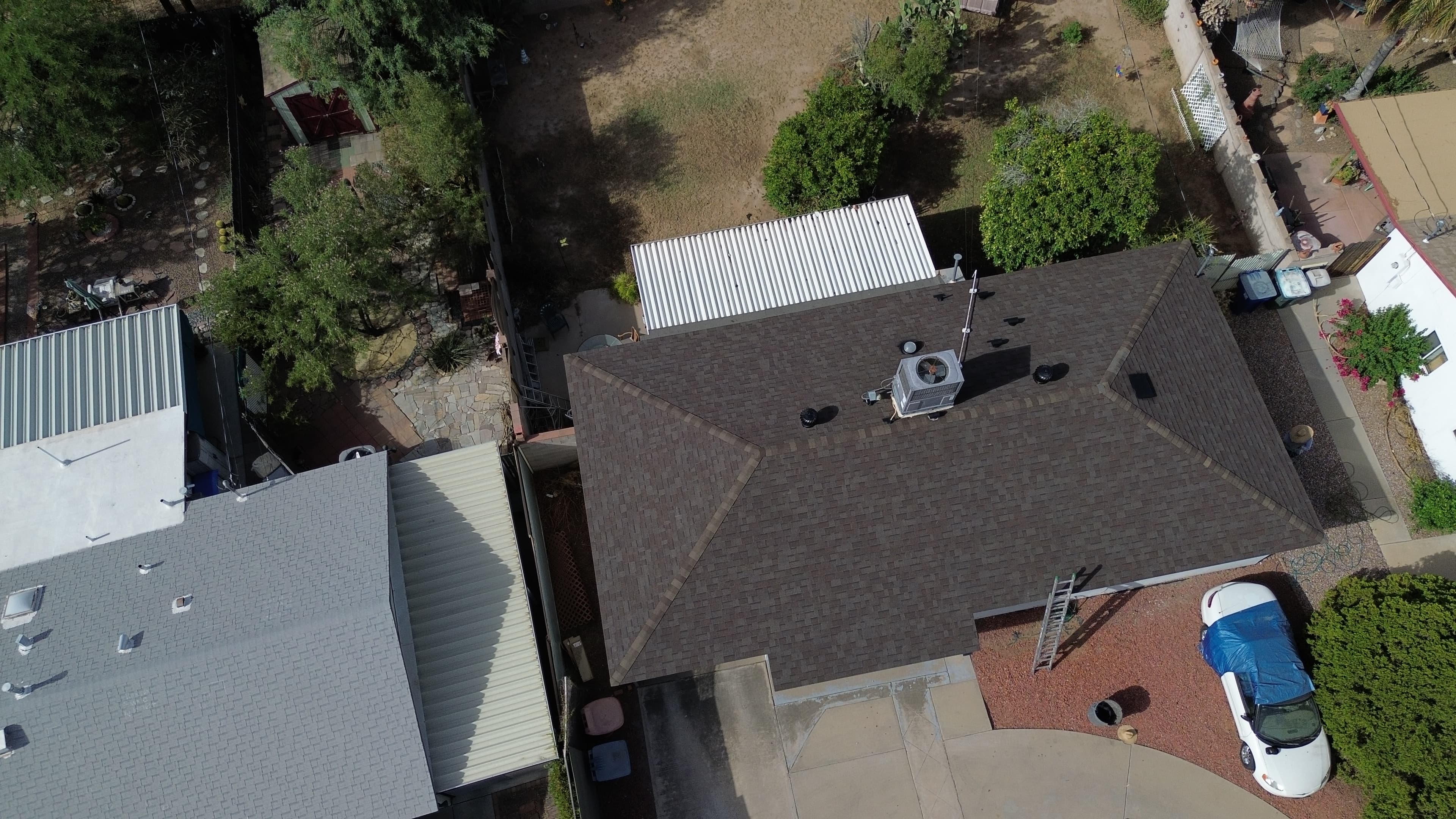
Tucson's flat commercial roofs see direct UV exposure with no shading, often on white or reflective TPO that's still hot enough to degrade adhesives and seam sealers faster than coastal climates. Reflective coating reapplication every 8–12 years is the default maintenance schedule for Tucson commercial.
- II
Federal-grade specs are different.
Fort Huachuca, Sierra Vista AFB, the Tucson VA, and other federal facilities require specific spec compliance, security clearance protocols, and documentation rigor that exceeds standard residential or private commercial. We've done enough of this work that the additional process isn't friction — it's routine.
- III
Phased work to keep buildings operational.
Most commercial clients can't shut the building down for a full re-roof. We phase the work — section by section, weekend or after-hours when needed — so retail stays open, offices stay occupied, schools stay in session. Coordinated with you up front, with a Gantt-chart timeline.
Signs to call
When commercial roof work is overdue.
- 01Visible damage on a flat or low-slope commercial roof — pooling, cracking, blistering.
- 02Interior leaks affecting tenants, equipment, or merchandise.
- 03Existing roof is past warranty (often 15–25 years for commercial) and you're seeing failure points.
- 04Energy bills climbing — a reflective coating or full reroof can dramatically reduce cooling cost on a large flat roof.
- 05New construction, addition, or major renovation — we work from architect specs.
Our approach
How a commercial project goes.
Step-by-step from inspection to walkthrough — the approach we follow on every job.
- 01
Site survey — we inspect the entire roof, identify all problem areas, and assess the existing system. For larger roofs we use drone mapping to document everything.
- 02
Written proposal with system options. We don't push the most expensive spec; we recommend what fits your building's use and your timeline.
- 03
Phased work plan when needed — we keep the building operational. Tenants stay, retail stays open, schools stay in session. We work around your schedule.
- 04
Materials sourced direct from manufacturers (modified bitumen, single-ply, shingle) with full warranty coverage. Federal-grade specs available where needed.
- 05
Final walkthrough with documentation, warranty registration, and recommended maintenance schedule.
The spec
Commercial systems and what shapes the price.
Timeline —Highly variable — small commercial recoats are 3–5 days. Mid-size full replacements run 2–4 weeks. Large multi-acre roofs are phased over 1–3 months. We give a Gantt-chart timeline with every commercial proposal.
What affects the cost —
- 01
Square footage — commercial scales by sq ft more directly than residential.
- 02
System spec — TPO, modified bitumen, PVC, or coating; each fits different uses and budgets.
- 03
Phased work — keeping the building operational adds coordination but keeps revenue flowing.
- 04
Federal vs. private — federal projects require additional documentation and on-site security compliance.
Where commercial roof projects go wrong — what we watch for.
Residential contractors doing commercial.
Commercial flat roofs use different systems, different attachment methods, and different code requirements than residential. Some contractors quote a low price by treating commercial like big residential. The result is failure within years. We use commercial-grade systems (TPO, modified bitumen, PVC) installed to manufacturer spec.
Wrong system spec for the use.
Restaurants generate grease vapor that destroys some membranes; PVC handles it. Warehouses with rooftop equipment need walking pads and reinforced systems. Schools need quiet install during hours. The system spec should match the use; some contractors quote whatever's cheapest.
No phased work plan.
Most commercial clients can't accept 'we shut down for two weeks.' We design phased work plans up front — section by section, after-hours, weekend, or by building wing — so the business keeps running. Some contractors don't offer phasing and force the shutdown.
Poor warranty documentation.
Manufacturer warranties on commercial roofs are valuable — typically 15–25 years if registered properly. Some contractors don't register warranties or skip the documentation steps that activate them. We handle warranty registration as part of every commercial job.
“Most commercial roof failures aren't material failures — they're install failures. The system did what the system does; it just wasn't installed for the building's actual use.”
Commercial roofing, common questions.
The questions we hear most before homeowners sign — pricing, timing, materials, warranty.
01Do you have federal project experience?
Yes — we've completed roofing work at Fort Huachuca, Sierra Vista AFB, and the Tucson VA. We're familiar with federal procurement, security clearances on-site, and the spec rigor those projects require.
02Can you keep our business open during the roof work?
Yes — almost always. We phase the work so the building stays operational. For retail and offices we typically work standard hours; for industrial or sensitive operations we can work nights or weekends. Coordinated with you up front.
03What's the right system for my commercial roof?
Depends on the building. For most flat commercial, TPO single-ply is the modern standard — long warranty, reflective, fast install. For high-traffic roofs (rooftop equipment, foot traffic) we lean toward modified bitumen. We'll spec what fits your use, not what's easiest for us.
04Do you handle warranty registration and ongoing maintenance?
Yes. We register manufacturer warranties on your behalf, provide documentation, and offer optional annual inspection plans to keep the warranty in force and catch issues before they become leaks.
05How long does a typical Tucson commercial roof project take?
Highly variable. Small commercial recoats are 3–5 days. Mid-size full replacements run 2–4 weeks. Large multi-acre roofs are phased over 1–3 months. We give a Gantt-chart timeline with every commercial proposal so you know what to expect day by day.
06What kind of commercial buildings do you work on?
Retail, restaurants, offices, schools, light industrial, warehouses, federal facilities, and HOA common-area buildings. We've done work along Speedway, Broadway, Fry Boulevard, the I-10 corridor, and inside Fort Huachuca and Sierra Vista AFB. Sizes range from a 5,000 sq ft retail space to multi-acre warehouse roofs.
07Do you offer maintenance contracts for commercial roofs?
Yes. Commercial roof maintenance plans typically include annual inspection, coating reapplication on schedule, drain cleaning, and emergency response. Worth it for any commercial building 20,000 sq ft and up. Pricing depends on roof size and access.
08Can you bid on federal contracts?
Yes — we have ROC license, bond, insurance, and prior federal project experience that meet most federal procurement requirements. We've been a successful bidder at Fort Huachuca and Sierra Vista AFB. For federal projects we add the additional documentation those contracts require — submittals, certifications, and security protocol.
Where we work
Commercial across the metro.
Pima County metro — click a city for area-specific work patterns, HOA standards, and recent jobs.
Reviewed by —Efren CoronadoOwner & lead estimator, Coronado Roofing. Tucson roofer since 2014. Commercial work spans federal projects at Fort Huachuca, Sierra Vista AFB, and the Tucson VA, plus retail and office along Tucson's main corridors. FAA Part 107 drone-certified.
Last updated —
Other services
What else we do.
Same crew, same drone-first inspection, same materials — across every kind of roof we work.
Ready for a real quote?
Drone inspection. Honest assessment. No pressure.
Mon–Fri · 7am–5pm·Saturday by appointment