
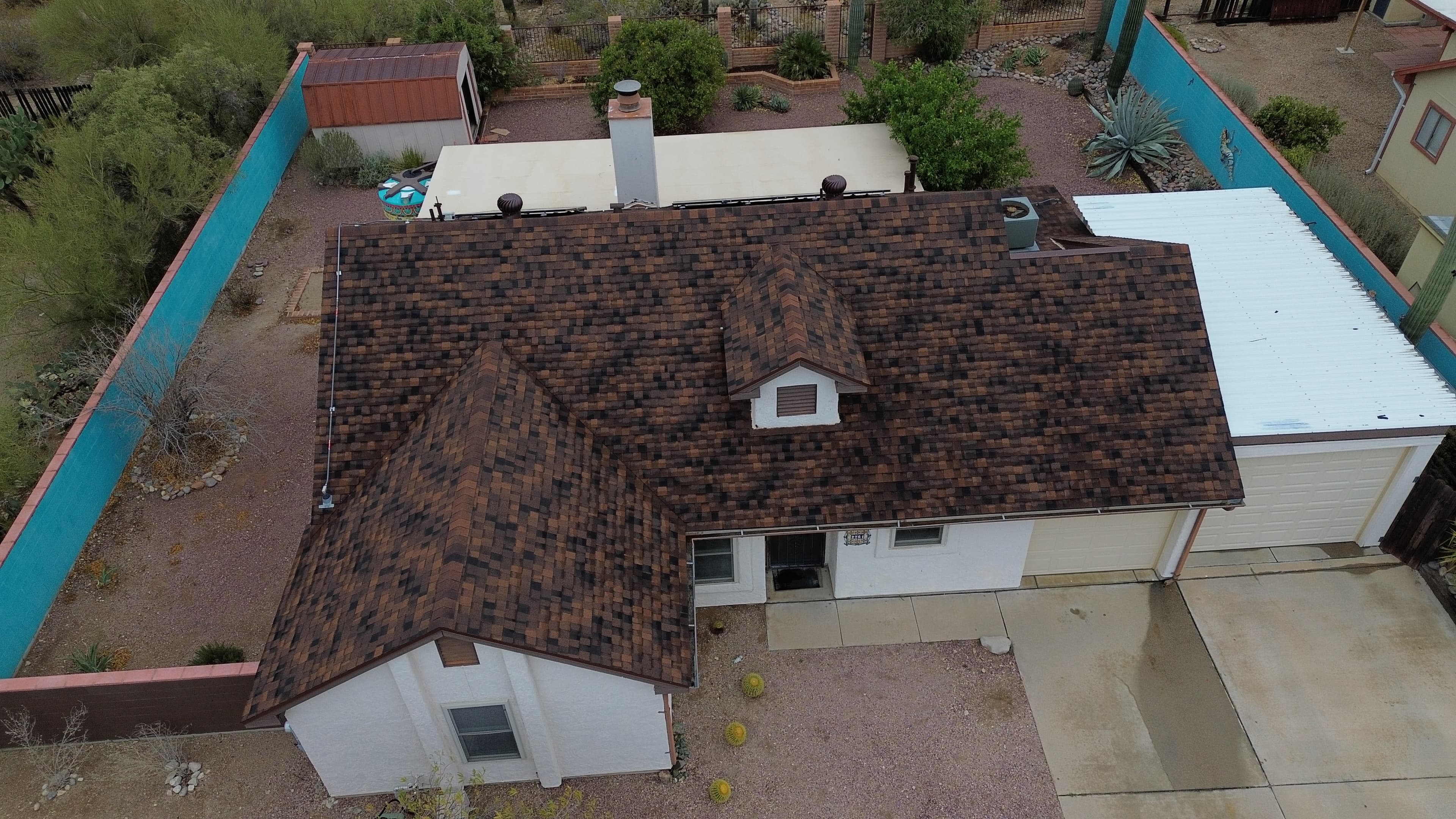
Services/Flat-roof coating/Tucson
Flat-roof coating in Tucson.
Pima County, Arizona
Flat-roof and low-slope work across Tucson — Speedway and Broadway commercial corridors, Sonoran-style ranch homes in the central core, mid-century homes in El Encanto and Sam Hughes, and the larger commercial properties along the I-10 corridor.
In short
Flat-roof coating in Tucson covers two distinct markets we work simultaneously: the central commercial corridor (Speedway, Broadway, Stone Avenue) where TPO single-ply, modified bitumen, and reflective coatings dominate, and the older Sonoran-style ranch homes through Sam Hughes, El Encanto, and the central core where original built-up roofs from the 1950s–80s have been recoated three or four times and now need either a fresh elastomeric coat or a full tear-off-and-replace. We do drone inspection plus on-roof substrate testing on every flat-roof quote, because the call between recoat and replace depends on what's actually under the surface.
Why this work, here
Flat-roof coating in Tucson is its own thing.
Field notes —
Why Coronado, here
Why hire Coronado for flat-roof coating in Tucson.
Specific to this combination — not generic family-owned-and-insured filler.
We test substrate before we coat it.
Most of the flat-roof recoat failures we see are coatings applied over substrates that were already done. We pressure-wash, do core sample testing on older built-up systems, and only coat over a sound substrate. If the substrate is failing, we tell you — sometimes the right call is a tear-off-and-replace, even when a coat would have been quoted by someone else.
Mid-century Sonoran experience matters.
Sam Hughes, El Encanto, Armory Park, and the older central core have a lot of 1950s–80s flat-roof Sonoran homes. After 50+ years of recoats, these substrates need careful evaluation. We've worked them for a decade; we know what's typically still salvageable and what isn't.
Federal-grade documentation on commercial work.
We've completed federal flat-roof projects at the Tucson VA, Fort Huachuca, and Sierra Vista AFB. The documentation rigor those projects require translates into stronger commercial work along Tucson's central corridors — proper warranty registration, inspection records, and material specs that hold up to insurance and audit review.
Phased work for occupied buildings.
Most Tucson commercial flat-roof clients can't shut down for two weeks. We design phased work plans up front — section by section, after-hours, weekend, or by building wing — so retail stays open, offices stay occupied, schools stay in session. Coordinated with you up front, with a Gantt-chart timeline.
Pricing
What shapes the price.
Flat-roof coating pricing in Tucson varies enormously by scope. The cheapest job we do is a small residential Sonoran-style recoat over a sound substrate (8–12 year life). The most expensive is a multi-acre commercial TPO replacement with phased install to keep the building operational. Major variables: square footage, existing substrate condition (recoat vs full replacement), system spec (elastomeric coating, modified bitumen, TPO, PVC), access constraints, and whether ponding correction is needed before new coating. We don't quote without inspection — and on commercial flat roofs we use drone plus on-roof substrate testing because what's visible from the air doesn't tell the whole story.
Full flat-roof coating pricing breakdownProcess
How it goes in Tucson.
- 01
Drone + substrate inspection
Drone reads the whole roof for ponding, blistering, cracking, and coating wear. On older substrates, we do on-roof core sample testing to confirm what's salvageable and what isn't.
- 02
Recoat-or-replace recommendation
Within 48 hours: written assessment with substrate condition, recommended path (recoat vs replace), and quotes for both when applicable. No upsell to replacement when recoat is the right call.
- 03
Itemized quote and phasing plan
Written quote with materials, labor, calendar timeline, and (for commercial) phased work plan keeping the building operational. Permit fees passed through at cost.
- 04
Substrate prep, install, walkthrough
Pressure-wash to a sound substrate, repair blisters and cracks, address ponding before coating, apply system per spec. For replacements: tear-off, decking inspection, new system install. Manufacturer warranty registered.
Flat-roof coating in Tucson — questions.
Specific to this combination — pricing, timing, materials, local conditions.
01Recoat vs full replacement on my Tucson flat roof — how do I decide?
Substrate condition. If pressure-washing reveals a sound substrate (no widespread blistering, no soft spots, no ponding-related rot), recoat works and lasts 8–12 more years. If the substrate shows widespread failure, a recoat over it just delays the inevitable while making the eventual tear-off harder. We do drone plus on-roof substrate testing and quote both options so you can decide.
02How much does a Tucson commercial flat-roof recoat cost?
Highly dependent on square footage, system spec, and access. A small commercial recoat — 5,000 sq ft TPO touch-up — is a different number than a 50,000 sq ft warehouse. Coating-only on a sound substrate is the cheapest path; full TPO replacement on a failed substrate is the most expensive. We give itemized quotes after the inspection — no estimates over the phone.
03Will a fresh reflective coating drop my Tucson AC bill?
Yes, measurably. A bright white reflective coating reflects 80%+ of solar radiation versus 10–25% for an older dark or oxidized roof. In Tucson summers, that translates to 10–20°F lower attic / interior plenum temperatures and meaningful cooling cost savings — most measurable on commercial buildings with large flat areas, but also noticeable on Sonoran ranch homes where the flat roof IS most of the total roof surface.
04How does Tucson UV affect flat-roof coatings differently than other climates?
Tucson UV is roughly 30% more intense than coastal climates at comparable latitudes. Coatings rated 12 years in California typically deliver 8 here. We default to higher-grade elastomerics with stronger UV resistance — slightly more expensive than entry-grade, but the lifecycle math works out because you skip a recoat cycle.
05Sonoran-style 1950s–70s flat-roof home — what's typical to find?
Built-up modified bitumen on a wood deck, originally installed when the home was built, recoated every 8–12 years through the decades. After 50+ years many substrates are at end of life — visible blistering, soft spots from wood-deck rot, water staining underneath. Recoat works if the substrate is sound; full tear-off-and-replace is needed when it's not. We do drone plus on-roof substrate testing to figure out which path makes sense.
06Do you do federal commercial flat-roof work?
Yes — we've completed federal projects at the Tucson VA, Fort Huachuca, and Sierra Vista AFB. We're familiar with federal procurement, security clearances on-site, and the spec rigor those projects require. ROC license, bond, insurance, and federal project history are current.
Other cities
Flat-roof coating elsewhere.
- Flat-roof coating in Marana
- Flat-roof coating in Sahuarita
- Flat-roof coating in Oro Valley
- Flat-roof coating in Vail
Reviewed by —Efren CoronadoOwner & lead estimator, Coronado Roofing. Tucson roofer since 2014, FAA Part 107 drone-certified, federal experience at Fort Huachuca, Sierra Vista AFB, and the Tucson VA.
Last updated —
Got a flat-roof coating need in Tucson?
Free drone inspection. Honest assessment. No pressure.
Mon–Fri · 7am–5pm·Saturday by appointment